
Choosing the Right Water Treatment Technology for Your Property
Clean, safe, and reliable water is essential for both homes and businesses — but not all water treatment solutions are created equal. From hard water and limescale to bacteria and dissolved contaminants, different water issues require different technologies to achieve real, lasting results.
Many systems on the market promise quick fixes, but choosing the right solution depends on understanding what’s actually in your water. That’s why effective water treatment starts with proper testing, followed by selecting the technology that matches your specific needs — whether it’s UV disinfection, reverse osmosis, water softening, or advanced filtration.
At DryZone, we take a practical, evidence-based approach to water treatment. By combining professional water testing with tailored system design and installation, we help you achieve consistent water quality you can rely on — without guesswork, unnecessary costs, or one-size-fits-all solutions.
What Are Water Treatment Technologies?
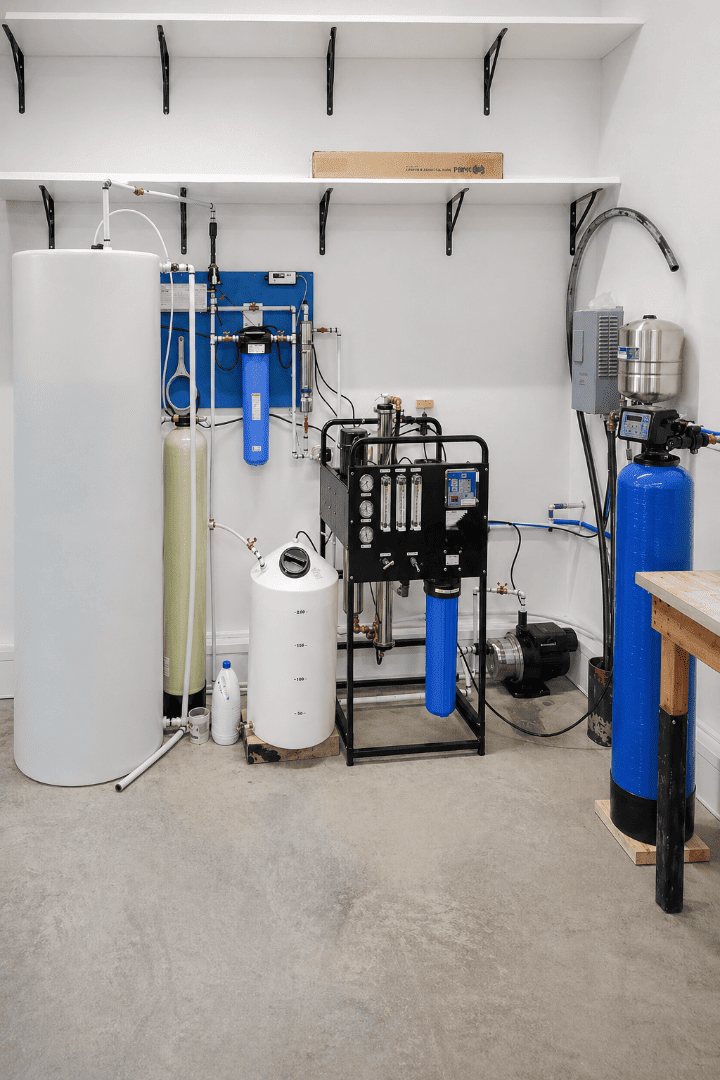
Water treatment technologies are systems designed to improve water quality by removing contaminants, reducing harmful substances, and improving overall safety and usability.
Different technologies address different types of water issues — from sediment and limescale to bacteria, nitrates, or dissolved metals. Because water conditions vary widely between properties and water sources, treatment usually involves selecting the right technology or combination of systems based on water testing results.
Why Choosing the Right Technology Matters
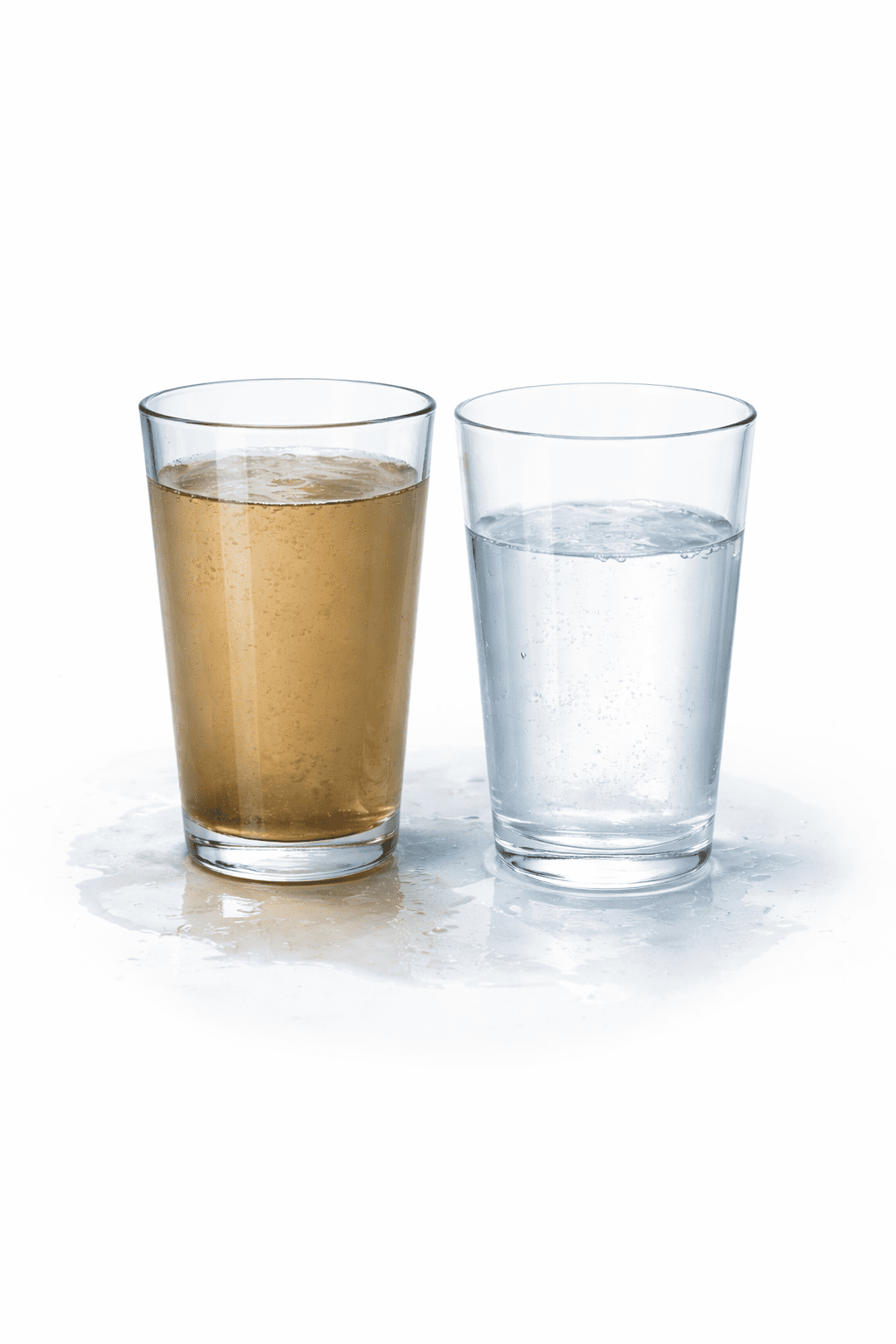
Choosing the right water treatment technology is essential for achieving consistent and reliable results. While many systems may appear similar, using the wrong solution can lead to ongoing water issues, unnecessary expenses, and frustration when the expected improvements don’t materialise.
Different water problems require different approaches. For example, a water softener will reduce limescale but won’t remove bacteria, while UV disinfection targets microorganisms but does not address hardness or dissolved contaminants. Without a clear understanding of what’s in your water, it’s easy to invest in a system that only solves part of the problem — or misses it entirely.
That’s why a structured, test-based approach is so important. By identifying the exact characteristics of your water before selecting a treatment system, you can ensure that the chosen technology delivers effective, long-term performance and avoids unnecessary costs or adjustments later on.
Main Types of Water Treatment Technologies
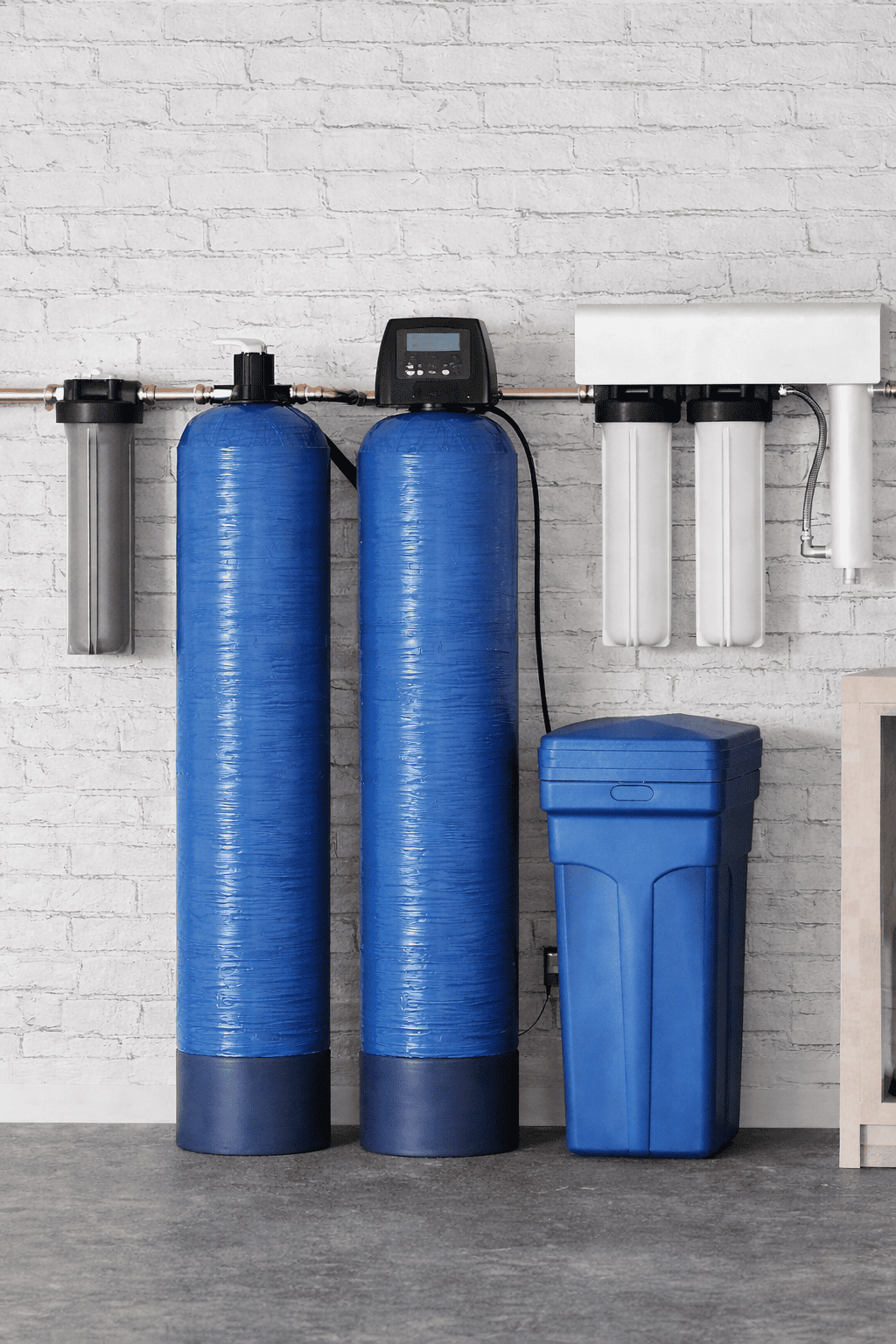
Water treatment technologies are designed to target specific water quality issues. In most cases, the best results are achieved by selecting the right system — or combining multiple technologies — based on the actual condition of your water.
Below is an overview of the most commonly used water treatment technologies and when they are typically applied.
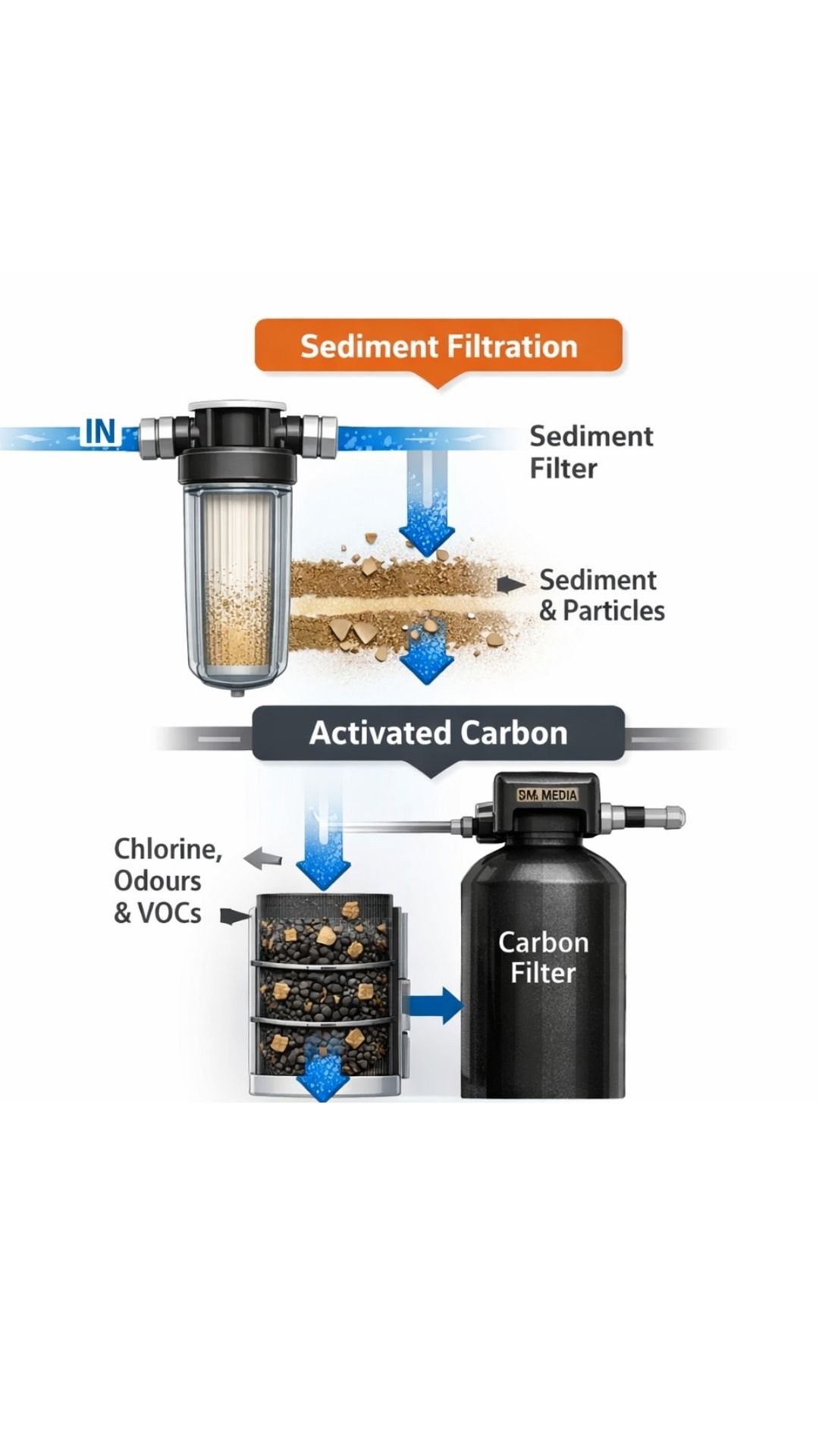
Sediment Filtration
What it removes
Suspended solid particles such as sand, silt, rust, clay, and other insoluble debris typically larger than 1–50 microns, depending on the filter rating.
How it works
Sediment filtration is used to remove suspended solids from water and protect downstream treatment equipment. Different types of sediment filters are selected according to particle size, sediment load and water flow requirements.
Screen and Mesh Filters
Used for larger particles such as sand, grit and coarse debris. Often installed as the first stage of treatment.
Spin-Down Filters
Separate and collect heavier particles such as sand and sediment. The accumulated material can be flushed out without replacing the filter.
Cartridge Sediment Filters
Capture finer suspended particles such as silt, rust and small debris. Available in different micron ratings depending on the required level of filtration.
Bag Filters
Used where higher flow rates or larger volumes of suspended solids need to be handled, including larger domestic and commercial systems.
Multi-Stage Sediment Filtration
Combines coarse and fine filtration in sequence. Larger particles are removed first, reducing the load on finer filters and protecting downstream treatment equipment.
When to use
Used as a pre-filtration stage to protect downstream systems such as carbon filters, water softeners, UV disinfection, or reverse osmosis from particulate fouling.
What it does NOT remove
- Dissolved minerals
- Hardness (calcium, magnesium)
- Iron or manganese in dissolved form
- Nitrates or salts
- Bacteria and viruses
- Chemical contaminants
Common mistakes
Installing sediment filtration as a stand-alone solution for water quality issues instead of using it as a pre-treatment stage within a multi-step treatment system.
Aeration
Aeration is a water treatment process used primarily for private well water containing dissolved iron, manganese, hydrogen sulfide and certain volatile gases. Rather than directly filtering these contaminants, aeration changes their form so they can be removed more effectively by the next treatment stage.
What It Removes
- Dissolved iron (Fe²⁺)
- Dissolved manganese (Mn²⁺)
- Hydrogen sulfide gas (H₂S), responsible for characteristic sulfur or “rotten egg” odours
- Certain volatile gases and compounds that can be released from water through air contact
How Aeration Works
Groundwater can contain iron and manganese in dissolved form. In this state, the water may initially appear clear because the metals are not yet present as visible particles.
Aeration introduces air and oxygen into the water. This promotes oxidation, converting dissolved iron and manganese into insoluble particles. These particles can then be captured by downstream filtration media.
The process can be simplified as:
Dissolved contaminant → Contact with oxygen → Oxidation → Solid particles → Filtration
For hydrogen sulfide, aeration can help release the gas from the water and reduce sulfur odours. The effectiveness of the process depends on contaminant concentration, water chemistry, contact time and the design of the aeration system.
Main Types of Aeration Systems
Air Injection Systems
Introduce compressed air directly into the water line. The air mixes with the water to promote oxidation before the water reaches the filtration stage.
Aeration and Contact Tanks
Provide additional time for air and water to interact. This can improve oxidation where dissolved contaminants require more contact time before filtration.
Venturi Aeration Systems
Use water flow to draw air into the system without a separate air compressor. Their performance depends on correct flow rate and pressure conditions.
Atmospheric Aeration Systems
Expose water to air in a non-pressurised tank before it is pumped through the next treatment stages. These systems may be used where stronger gas release or extended aeration is required.
Why Filtration Is Required After Aeration
Aeration is normally a treatment stage, not a complete filtration system.
Once dissolved iron and manganese are oxidised, they become suspended particles. If these particles are not removed by suitable downstream filtration, they can continue into the plumbing system, causing discoloured water, sediment, staining and deposits.
For this reason, a typical treatment sequence may be:
Private Well → Aeration / Oxidation → Contact Time → Iron and Manganese Filtration → Further Treatment as Required
The exact configuration depends on the water test results, flow rate and contaminant levels.
Media Filtration Systems
Sand, Multimedia, Activated Carbon, Catalytic and KDF Media
Media filtration systems use pressurised vessels or filter housings containing specialised treatment media. Depending on the media selected, these systems can remove suspended solids, capture oxidised metals, reduce chlorine and organic compounds, or support the treatment of iron, manganese and hydrogen sulfide.
These technologies should not be treated as interchangeable. Sand, activated carbon, catalytic media and KDF work through different mechanisms and are selected according to the water analysis and the treatment objective.
How Media Filtration Works
Water passes through one or more layers of treatment media inside a filtration vessel. Contaminants are removed through different processes depending on the media used:
- Mechanical filtration captures suspended particles within the media bed.
- Adsorption attracts and retains certain dissolved contaminants on the surface of the media.
- Catalytic oxidation accelerates reactions that convert dissolved contaminants into forms that can be filtered.
- Redox reactions change the chemical state of certain contaminants.
A treatment system may use a single media type or a carefully designed combination of media. The correct configuration depends on water chemistry, contaminant concentration, flow rate and the treatment stages installed before and after the filter.
Sand Filtration
Sand filtration is primarily used to remove suspended solids from water. As water passes through the filter bed, particles are trapped between and within the media.
Typically used for:
- Sand and silt
- Suspended solids
- Rust particles
- Oxidised iron and manganese
- Reduction of turbidity
Sand filters are often used after settlement, aeration or oxidation, where dissolved contaminants have already been converted into particles.
They are not designed to remove dissolved hardness, nitrates, salts or microorganisms.
Multimedia Filtration
Multimedia filters use several layers of filtration media with different particle sizes and densities. This allows suspended material to be captured throughout the depth of the filter bed rather than mainly at the surface.
A typical multimedia configuration may contain layers such as anthracite, sand and supporting gravel, although the exact design varies.
Compared with a single-media filter, a correctly designed multimedia system can:
- Handle a higher suspended solids load
- Provide deeper filtration
- Reduce rapid surface clogging
- Extend the time between backwash cycles
- Protect downstream treatment equipment
Multimedia filtration is commonly used where water contains significant turbidity, sediment or oxidised metals.
Activated Carbon Filtration
Activated carbon works mainly through adsorption. Its highly porous surface attracts and retains certain contaminants as water passes through the media.
Typically used for:
- Chlorine
- Taste and odour problems
- Many organic compounds
- Selected chemical contaminants, depending on the carbon type and contact time
Activated carbon is commonly used for mains water containing chlorine and as a polishing stage in whole-house and drinking water systems.
Carbon performance depends heavily on:
- Carbon type
- Media volume
- Water flow rate
- Empty bed contact time
- Contaminant concentration
- Replacement or backwashing schedule
Activated carbon is not a universal chemical filter. It does not reliably remove hardness, nitrates, dissolved salts or all heavy metals.
Catalytic Filtration Media
Catalytic media provide an active surface that promotes oxidation and filtration of selected contaminants. Depending on the media type and water chemistry, they may be used for:
- Iron
- Manganese
- Hydrogen sulfide
- Other oxidisable contaminants
Some catalytic media can operate using dissolved oxygen already present in the water. Others require additional oxidation using aeration or another correctly controlled pretreatment stage.
Performance depends strongly on factors such as:
- pH
- Oxidation-reduction potential (ORP)
- Dissolved oxygen
- Contaminant concentration
- Contact time
- Service flow rate
This is why the presence of iron or manganese alone is not enough to select a catalytic filter.
KDF Filtration Media
KDF media use a high-purity copper-zinc alloy and operate through oxidation-reduction reactions.
Depending on the specific KDF media and system design, they may be used to support the reduction of:
- Chlorine
- Certain dissolved metals
- Hydrogen sulfide
- Scale and biological growth within some treatment configurations
KDF is often used together with other filtration media rather than as a complete standalone treatment system.
Because KDF media are dense and require correct hydraulic conditions, system design, flow rate and backwashing requirements are important considerations.
Single-Media and Multi-Media Systems
Not every property requires the same filtration vessel.
A system may contain:
- A single media selected for one specific treatment objective
- Several media layers within one vessel
- Multiple vessels arranged in sequence
- Pretreatment followed by media filtration and final polishing
For example:
Private Well → Aeration / Oxidation → Catalytic or Multimedia Filtration → Further Treatment
or:
Mains Water → Sediment Protection → Activated Carbon → Further Treatment if Required
The treatment sequence should be based on the actual contaminants present rather than on the assumption that one media can solve every water problem.
Iron Removal Systems
What it removes
- Dissolved iron (ferrous iron, Fe²⁺)
- Oxidized iron particles (ferric iron, Fe³⁺)
- Iron-related turbidity
- Metallic taste and reddish staining
How it works
Iron removal systems rely on oxidation followed by filtration.
Dissolved ferrous iron is converted into insoluble ferric iron using aeration, catalytic filtration media, or chemical oxidants. The resulting particles are then captured within the filtration media bed.
When to use
Applied when water analysis shows elevated iron concentrations, most commonly in private wells and groundwater supplies where iron causes staining, taste issues, and plumbing deposits.
What it does NOT remove
- Hardness minerals (calcium and magnesium)
- Nitrates and nitrites
- Dissolved salts and high TDS
- Organic contaminants
- Viruses and most bacteria
- Radon gas
Common mistakes
- Attempting to remove dissolved iron with sediment filters, which only capture particulate matter.
- Installing iron filters without proper oxidation, preventing iron from converting into filterable particles.
- Oversizing or undersizing the system without considering iron concentration and flow rate.
Nitrate Removal Systems
What it removes
- Nitrates (NO₃⁻)
- Nitrites (NO₂⁻)
How it works
Nitrate removal is typically achieved through ion exchange or reverse osmosis.
- Ion exchange systems use a specialized anion resin that replaces nitrate ions with chloride ions.
- Reverse osmosis systems remove nitrates through semi-permeable membrane separation, rejecting dissolved ions and contaminants.
When to use
Used when water testing confirms elevated nitrate levels, most commonly in private wells located near agricultural areas, septic systems, or fertilizer runoff zones.
What it does NOT remove
- Suspended solids and sediment
- Hardness minerals (unless a separate softening stage is used)
- Iron or manganese (without pretreatment)
- Chlorine taste and odor
- Bacteria and viruses (unless add
Common mistakes
- Installing nitrate treatment without laborat, which can lead to incorrect system selection.
- Using standard carbon or sediment filters, which do not remove dissolved nitrates.
- Operating ion exchange systems without proper regeneration maintenance, reducing nitrates.
Water Softeners
What it removes
- Calcium (Ca²⁺)
- Magnesium (Mg²⁺)
- Hardness minerals responsible for scale formation
How it works
Water softeners use ion exchange technology.
Hardness minerals (calcium and magnesium) are exchanged for sodium or potassium ions as water passes through a cation exchange resin bed. The resin is periodically regenerated using a brine solution to restore exchange capacity.
When to use
Installed when water analysis confirms hard water conditions, typically where scale buildup affects plumbing, heating systems, appliances, and fixtures.
What it does NOT remove
- Nitrates and nitrites
- Dissolved salts and high TDS
- Iron and manganese (in most cases without pretreatment)
- Chlorine and organic contaminants
- Bacteria and viruses
- Sediment and suspended solids
Common mistakes
- Installing a softener without pre-filtration, allowing sediment to damage the resin.
- Using a softener to treat high iron levels, which can foul the resin and reduce performance.
- Incorrect system sizing that does not match household flow rate or hardness concentration.
UV Disinfection Systems
What it removes
UV systems do not physically remove contaminants but inactivate microorganisms, including:
- Bacteria (e.g., E. coli, coliform bacteria)
- Viruses
- Protozoa (e.g., Giardia, Cryptosporidium)
How it works
Water flows through a UV reactor chamber where it is exposed to ultraviolet radiation at approximately 254 nm.
This wavelength penetrates microbial cells and damages their DNA and RNA, preventing replication and effectively rendering microorganisms inactive.
When to use
Used when water testing indicates microbiological contamination risk, particularly in private wells, surface water supplies, or systems requiring chemical-free disinfection.
What it does NOT remove
- Sediment and suspended particles
- Iron and manganese
- Hardness minerals (calcium and magnesium)
- Nitrates and nitrites
- Dissolved salts and high TDS
- Chemical contaminants
- Taste, odor, or color issues
Common mistakes
- Installing UV systems without proper pre-filtration, allowing turbidity, iron, or manganese to reduce UV penetration.
- Failing to replace the UV lamp annually, which lowers disinfection intensity over time.
- Neglecting quartz sleeve cleaning, causing mineral deposits that block UV transmission.
- Using UV as a solution for chemical contamination or turbidity, which UV technology cannot treat.
Reverse Osmosis (RO) Systems
What it removes
- Dissolved salts and high total dissolved solids (TDS)
- Nitrates and nitrites
- Fluoride
- Heavy metals (lead, arsenic, mercury, cadmium)
- Many organic compounds and pesticides
- Microorganisms (bacteria, viruses, protozoa)
How it works
Reverse osmosis uses a semi-permeable membrane that allows water molecules to pass while rejecting dissolved ions and contaminants.
Pressure forces water through the membrane, separating it into purified permeate and concentrated reject water (brine).
When to use
Used when water contains high TDS, nitrates, heavy metals, or multiple dissolved contaminants, particularly for drinking water purification systems.
What it does NOT remove
- Large suspended solids (without pre-filtration)
- Chlorine and oxidants that can damage RO membranes
- Dissolved gases such as hydrogen sulfide
- Hardness scaling without proper pretreatment
Common mistakes
- Installing RO systems without sediment and carbon pre-filtration, leading to membrane fouling or chlorine damage.
- Using RO for whole-house treatment, despite its low flow rate and wastewater production.
- Ignoring membrane maintenance and periodic replacement, which reduces contaminant rejection efficiency.
What Can Go Wrong with the Wrong Water Treatment System
| Technology | What It Removes | How It Works | When to Use | Limitations |
|---|---|---|---|---|
| Sediment Filtration (Mechanical) | Sand, silt, rust, particles | Physical barrier (micron filtration) | As pre-treatment for almost all systems | Does not remove dissolved contaminants, bacteria or chemicals |
| Aeration | Iron (dissolved), manganese, hydrogen sulphide (odour) | Adds oxygen to oxidise dissolved metals and gases | Well water with iron, staining, or smell | Requires filtration after oxidation |
| Sand / Multimedia Filters | Suspended solids, turbidity, oxidised iron | Multi-layer media traps particles | After aeration or for dirty water | Not effective for dissolved contaminants |
| Activated Carbon | Chlorine, taste, odour, organic compounds | Adsorption process using carbon media | Municipal water, improving taste and smell | Limited effect on heavy metals and bacteria |
| Catalytic Media | Iron, manganese, hydrogen sulphide | Accelerates oxidation and filtration | Higher levels of iron/manganese | Requires correct flow rate and maintenance |
| Iron Removal (Oxidation Systems) | Iron, manganese | Oxidation (air/chemical) + filtration | Well water with staining or metallic taste | Needs correct setup depending on iron type |
| Nitrite | Nitrites (NO₂) | Typically treated via ion exchange or RO | Contaminated well water | Requires accurate testing and system design |
| Nitrate Removal | Nitrates (NO₃) | Ion exchange or reverse osmosis | Agricultural areas / private wells | Requires maintenance and monitoring |
| Water Softeners | Hardness (calcium, magnesium) | Ion exchange replaces minerals with sodium | Hard water, limescale issues | Does not remove bacteria, nitrates, or iron effectively |
| UV Systems | Bacteria, viruses, microorganisms | UV light neutralises pathogens | Microbiological contamination (wells) | Requires clear water and pre-filtration |
| Reverse Osmosis | Heavy metals, nitrates, salts, chemicals | Semi-permeable membrane filtration | Drinking water systems | Produces waste water, usually point-of-use |
Key Water Treatment Technologies and What They Remove
Different water treatment technologies are designed to remove specific types of contaminants. The overview below shows what each system typically removes and its main limitations.In many real-world installations, multiple technologies are combined to address different water quality issues effectively.
| Technology | Removes | Limitations |
|---|---|---|
| Sediment Filtration | Sand, rust, particles | Does not remove dissolved contaminants |
| Activated Carbon | Chlorine, odour, organic compounds | Limited effect on bacteria and nitrates |
| Water Softener | Hardness (calcium, magnesium) | Does not remove bacteria or chemicals |
| Iron Removal Systems | Iron, manganese | Requires proper oxidation and filtration |
| UV Disinfection | Bacteria, viruses | Requires clear water and pre-filtration |
| Reverse Osmosis | Nitrates, heavy metals, dissolved solids | Typically used for drinking water only |
Which Technology Solves Which Water Problem?
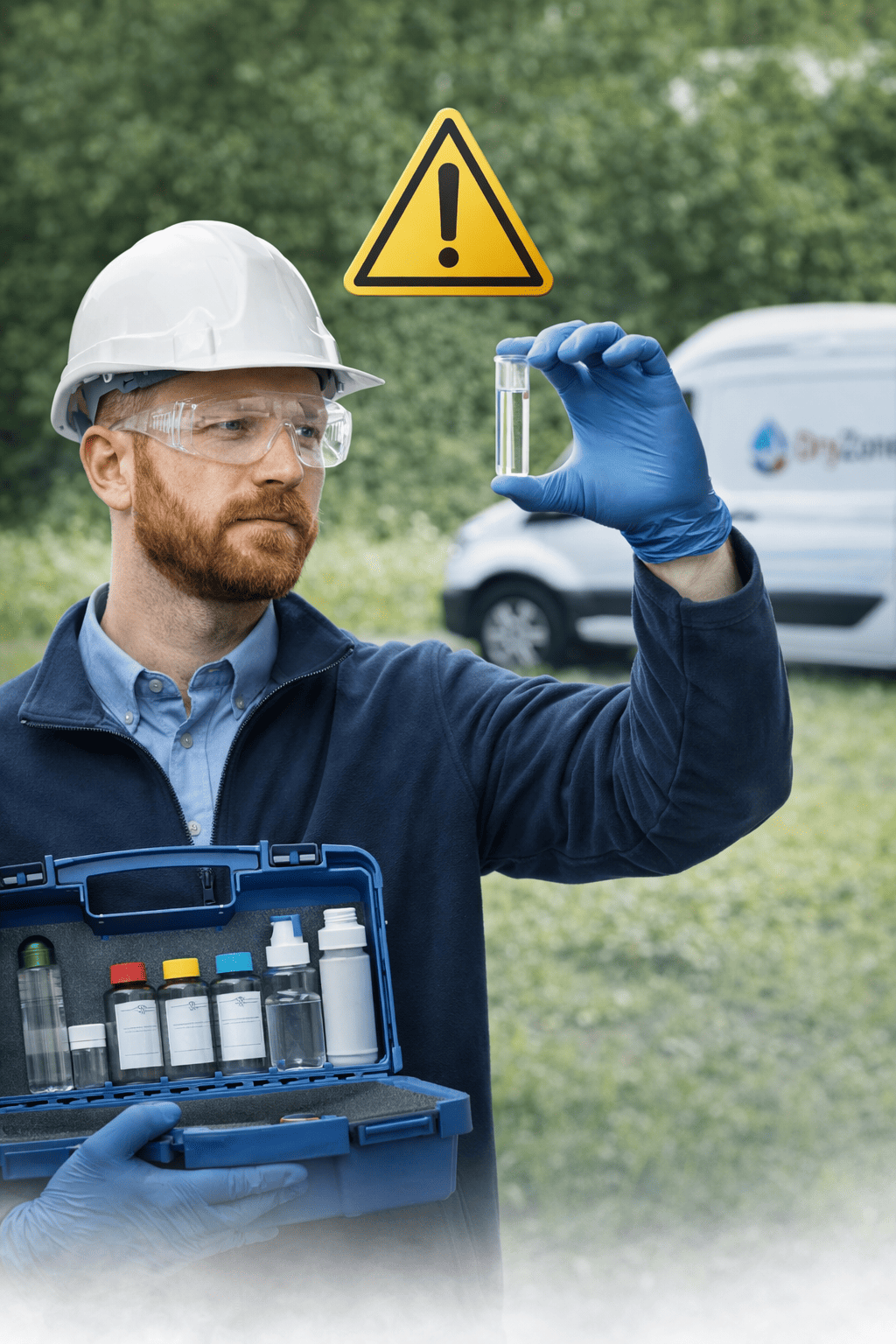
Different water quality issues require different treatment approaches. Identifying the exact problem is the key to choosing a system that delivers effective and long-lasting results.
The overview below shows how common water problems are typically addressed using specific treatment technologies.
In many cases, water contains more than one issue, which means a single system may not be enough to fully resolve the problem. Combining technologies — such as filtration, softening, and disinfection — often provides the most reliable and consistent results.
Examples of Water Treatment System Combinations
Water treatment systems are rarely built around a single technology.
In practice, several treatment stages are combined to address specific water chemistry, contamination risks, and household or commercial water demand.
The configuration of a system depends on factors such as:
- water source (private well or municipal supply)
- mineral composition
- presence of bacteria or dissolved metals
- treatment goals (drinking water quality, equipment protection, or full-house purification)
Below are examples of common system configurations used for different types of water conditions and treatment needs.
These examples illustrate how multiple technologies work together within a complete water treatment solution.
Example System Configurations
Sediment filtration + Activated Carbon
Basic treatment for municipal water to remove particles, chlorine, and improve taste and odor.
Sediment filtration + Activated Carbon + Reverse Osmosis
Typical drinking water purification system used to remove dissolved contaminants such as nitrates, heavy metals, and high TDS.
Sediment filtration + Activated Carbon + Reverse Osmosis + Remineralization
Advanced drinking water treatment where purified water is rebalanced with essential minerals to improve taste and stability.
Sediment filtration + Water Softener + UV Disinfection
Common whole-house configuration for hard well water with microbiological risk.
Sediment filtration + Water Softener + Carbon filtration + UV Disinfection
Multi-stage treatment used when water contains hardness, chlorine or organic contaminants, and potential bacterial contamination.
Sediment filtration + Aeration + Activated Carbon (sometimes with chemical oxidation)
System designed to treat iron, manganese, and hydrogen sulfide odors commonly found in groundwater.
Aeration + Sediment filtration + KDF media + Water Softener + UV Disinfection
Complex multi-stage system used where water contains metals, hardness, and microbiological contamination risks.
Sediment filtration + Oxidation + Water Softener + UV Disinfection
Typical configuration for well water with dissolved iron and hardness, combined with final microbiological protection.
⚠️ Important:
These configurations are only examples of system combinations. The correct treatment system must always be determined based on laboratory water analysis and site conditions.
This process provides confidence that your water treatment system is not only installed correctly, but also delivering the results it was designed for.

Why Water Testing Should Come Before Installation
Choosing a water treatment system without testing your water can lead to ineffective solutions, unnecessary costs, or systems that fail to address the real problem. While issues like limescale or discolouration may be visible, many contaminants — including bacteria, nitrates, and dissolved metals — cannot be detected without proper analysis.
Professional water testing provides accurate information about your water composition. Based on these results, the appropriate technology or combination of systems can be selected, ensuring the treatment system addresses the actual issue rather than symptoms.
Test → Design → Install → Verify
A structured approach to water treatment ensures reliable results at every stage:
-
Design – Select the right technology or combination of systems
-
Install – Set up the system for optimal performance
-
Verify – Confirm that the treatment is working as expected
This process provides confidence that your water treatment system is not only installed correctly, but also delivering the results it was designed for.

What Water Testing Reveals vs Guesswork
Before choosing a water treatment system, it’s important to understand the difference between decisions based on accurate testing and those based on assumptions. While some issues may seem obvious, many water quality problems are not visible and can easily be overlooked.
The comparison below shows how proper testing provides clarity — and why relying on guesswork often leads to incomplete or ineffective solutions.
Common Water Problems and Recommended Solutions
| Water Problem | Recommended Technology | What It Solves | Notes |
|---|---|---|---|
| Bacteria & Microorganisms | UV Disinfection | Neutralises harmful bacteria and viruses | Requires pre-filtration for best performance |
| Hard Water (Limescale) | Water Softener | Removes calcium and magnesium | Protects plumbing and appliances |
| Iron & Manganese | Media Filtration | Removes staining and metallic taste | Common in private well water |
| Sediment / Cloudy Water | Sediment Filtration | Removes particles and turbidity | Often used as pre-treatment |
| Nitrates / Dissolved Contaminants | Reverse Osmosis | Reduces dissolved substances | Typically used for drinking water |
| Bad Taste & Odour | Carbon Filtration / RO | Improves taste and smell | Depends on source of contamination |
| Multiple Water Issues | Combined System | Addresses several problems at once | Requires professional assessment |
Without accurate testing, it’s easy to focus only on visible symptoms while missing underlying issues that affect water quality. A test-based approach ensures that every aspect of the problem is identified and addressed, leading to a more effective, reliable, and long-term solution.
Why Choose DryZone for Water Treatment Technologies
| What We Offer | What It Means for You |
|---|---|
| Evidence-Based Recommendations | Systems are selected based on real water test results, not assumptions |
| Custom Solutions for Irish Water | Treatment systems tailored to local water conditions and specific property needs |
| Complete Service (Testing → Installation) | One provider for the entire process, ensuring consistency and reliability |
| Residential & Commercial Expertise | Solutions designed for both homes and business environments |
| Post-Installation Verification | Confidence that your system is working as intended after installation |
| Ongoing Maintenance & Support | Long-term performance with professional servicing and support |
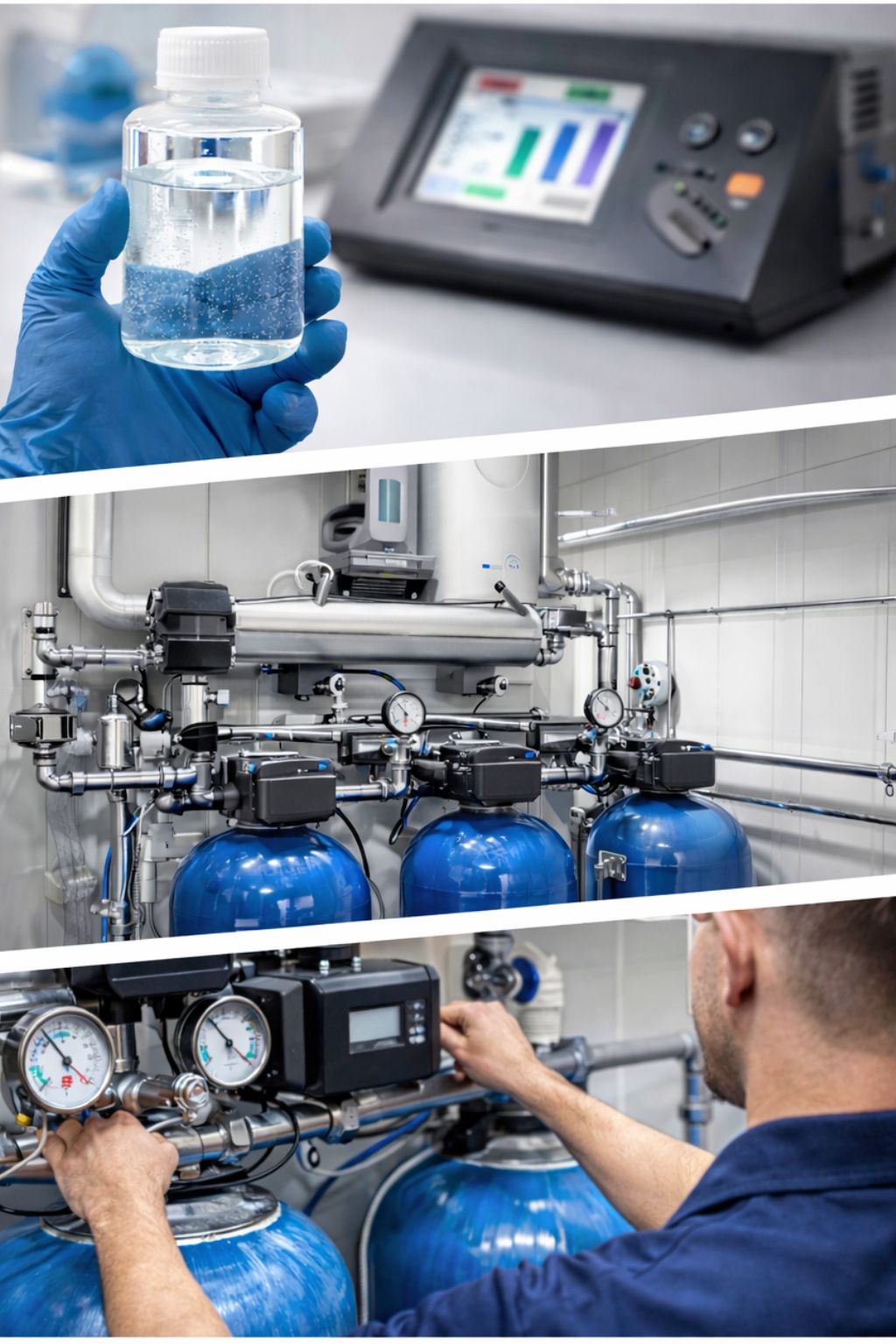
By combining accurate testing, tailored system design, and ongoing support, DryZone ensures that every water treatment solution delivers reliable, long-term results — without unnecessary complexity or guesswork.
Professional Water Treatment Technologies for Homes and Businesses
We provide reliable water treatment solutions designed to suit both residential and commercial properties.
Hard water is one of the most common water quality issues in both homes and businesses, leading to limescale buildup in pipes, heating systems, and appliances. Water softeners are designed to remove calcium and magnesium, helping to protect equipment and improve overall system performance.
✔️ Reduce limescale in pipes, boilers, and appliances
✔️ Improve efficiency of heating and water systems
✔️ Extend the lifespan of equipment
✔️ Suitable for residential and commercial properties
Filtration systems are used to remove sediment, particles, and other impurities that affect water clarity and quality. These systems are often installed at the main water entry point to provide whole-property protection.
✔️ Remove sediment and suspended particles
✔️ Protect pipework and water-using equipment
✔️ Improve water clarity and consistency
✔️ Suitable for a wide range of water conditions
Iron and manganese are commonly found in groundwater and private wells. These minerals can cause staining, unpleasant taste, and buildup in plumbing systems if not properly treated.
✔️ Prevent staining on fixtures and surfaces
✔️ Improve water appearance and taste
✔️ Protect plumbing and equipment
✔️ Ideal for private well water supplies
→ Learn About Iron & Manganese Removal
Nitrates can be present in certain water sources, particularly in rural areas and private wells. Dedicated treatment systems help reduce nitrate levels and improve overall water quality for safe daily use.
✔️ Reduce nitrate levels in water
✔️ Improve water safety and quality
✔️ Suitable for private wells and rural properties
✔️ Reliable long-term solution
→ Learn About Nitrate Removal
UV disinfection systems provide chemical-free protection against bacteria and microorganisms. They are widely used where microbiological safety is a concern, especially in private water supplies.
✔️ Effective protection against bacteria and viruses
✔️ Continuous disinfection without chemicals
✔️ Works alongside filtration systems
✔️ Ideal for well water and untreated sources
The right water treatment solution depends on the specific characteristics of your water. Since many issues are not visible, professional water testing is the most reliable way to identify the problem and select the correct technology or combination of systems.
A test-based approach ensures that your investment delivers effective, long-term results — without unnecessary costs or guesswork.
• Professional Water Testing (Home & Business)
• Private Well Water Analysis
• Bacteria, Nitrate, Iron & Hardness Testing
• Pre-Installation Water Assessment
• Post-Treatment Verification Testing
• Water Softeners (Hard Water Treatment)
• Whole-Property Filtration Systems
• Iron & Manganese Removal
• Nitrate Reduction Systems
• UV Water Disinfection
• Well Disinfection (Shock Chlorination)
• Sediment & Borehole Filtration
• Bacteria Protection Systems
• Combined Treatment for Multiple Issues
• Custom Water Treatment System Design
• Professional Installation
• System Configuration for Optimal Performance
• Integration of Multiple Technologies
• Post-Installation Performance Checks
• Scheduled Servicing & System Checks
• Filter Replacement Programmes
• UV Lamp Replacement
• System Performance Monitoring
• Water Quality Re-Testing
• Long-Term Support
Serving Clare, Limerick, Galway & Tipperary
- County Clare (Shannon, Ennis, Killaloe, Kilrush, Scarriff, Tulla, Newmarket‑on‑Fergus, Sixmilebridge, Bunratty, Clarecastle, Quin , Cratloe and more)
- County Limerick (including Limerick city and surrounding areas)
- County Galway (Gort & especially the southern and eastern areas)
- County Tipperary (Nenagh, Borrisokane, and nearby)
If you’re not sure whether we serve your area, just send us a message — we’ll do our best to assist.

FAQ Water Treatment Technologies
The best water treatment system depends on the specific characteristics of your water. Different issues — such as hardness, bacteria, iron, or nitrates — require different technologies. Professional water testing is the most reliable way to identify the problem and select the right solution.
Yes, water testing is strongly recommended before installing any treatment system. Many water issues are not visible, and without testing it’s easy to choose a system that only partially solves the problem or misses it completely.
In most cases, no single system can address all water quality issues. Many properties require a combination of technologies — such as filtration, softening, and disinfection — to achieve the best results.
A water softener removes hardness (calcium and magnesium) to prevent limescale, while filtration systems remove particles, iron, or other impurities. These technologies solve different problems and are often used together.
UV disinfection is highly effective at neutralising bacteria and microorganisms, but it does not remove sediment, hardness, or dissolved contaminants. For best performance, UV systems are often combined with filtration.
Regular maintenance is essential to keep systems working effectively. Service frequency depends on the type of system, but typically includes filter replacements, system checks, and UV lamp replacement where applicable.
Yes, combining multiple technologies is often the most effective approach. For example, filtration can remove particles, a softener can treat hardness, and UV can provide disinfection — working together as a complete system.
Yes, DryZone offers a complete service including water testing, system design, installation, and post-installation verification. This ensures the system is correctly selected and performs as expected.
