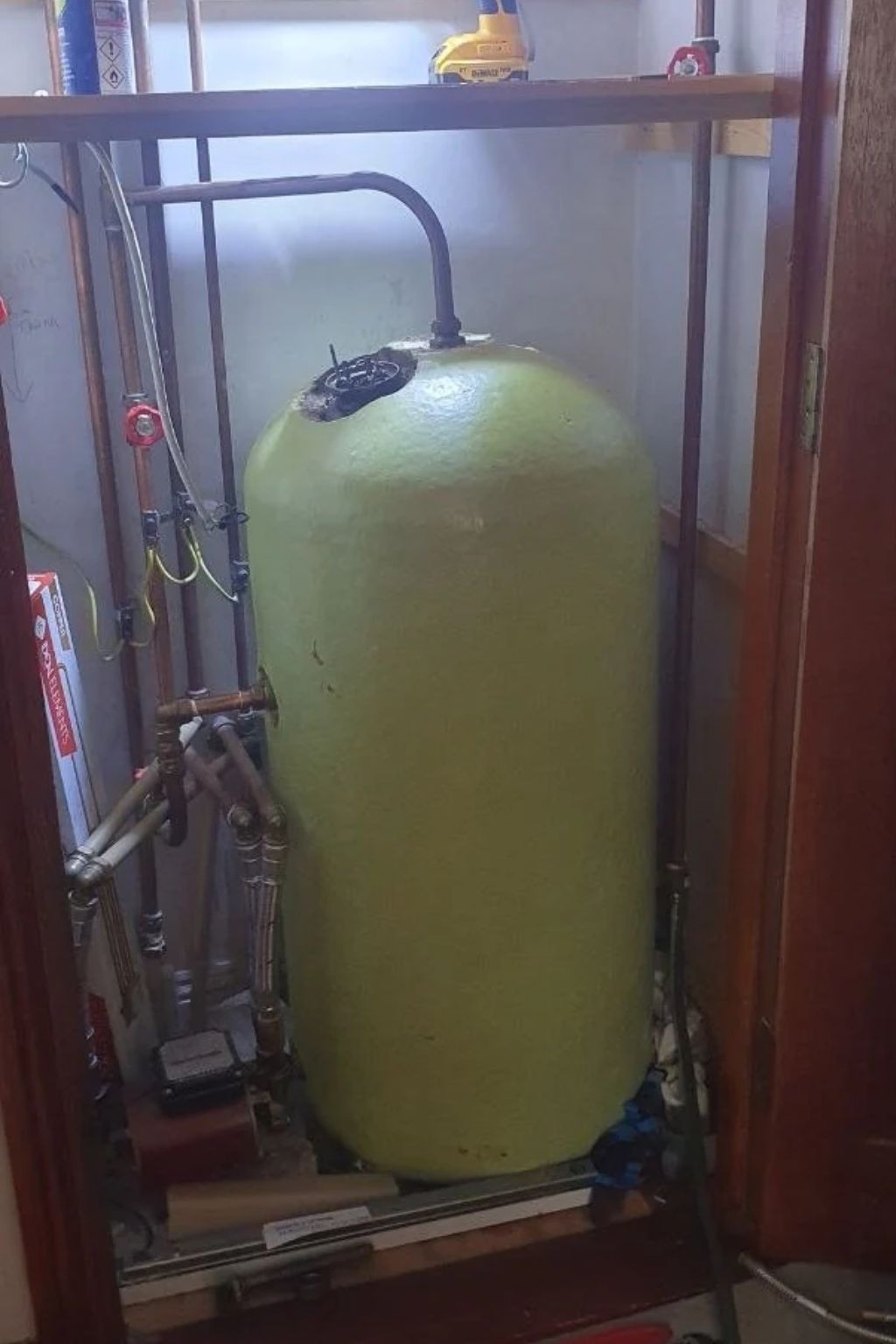
Hot Water Cylinder Cleaning
Over time, deposits inside a hot water cylinder can affect heating efficiency, reduce performance and place additional strain on the system.
DryZone provides professional hot water cylinder cleaning to address these issues, helping homeowners maintain reliable hot water, protect their equipment and avoid unnecessary repairs or premature replacement.
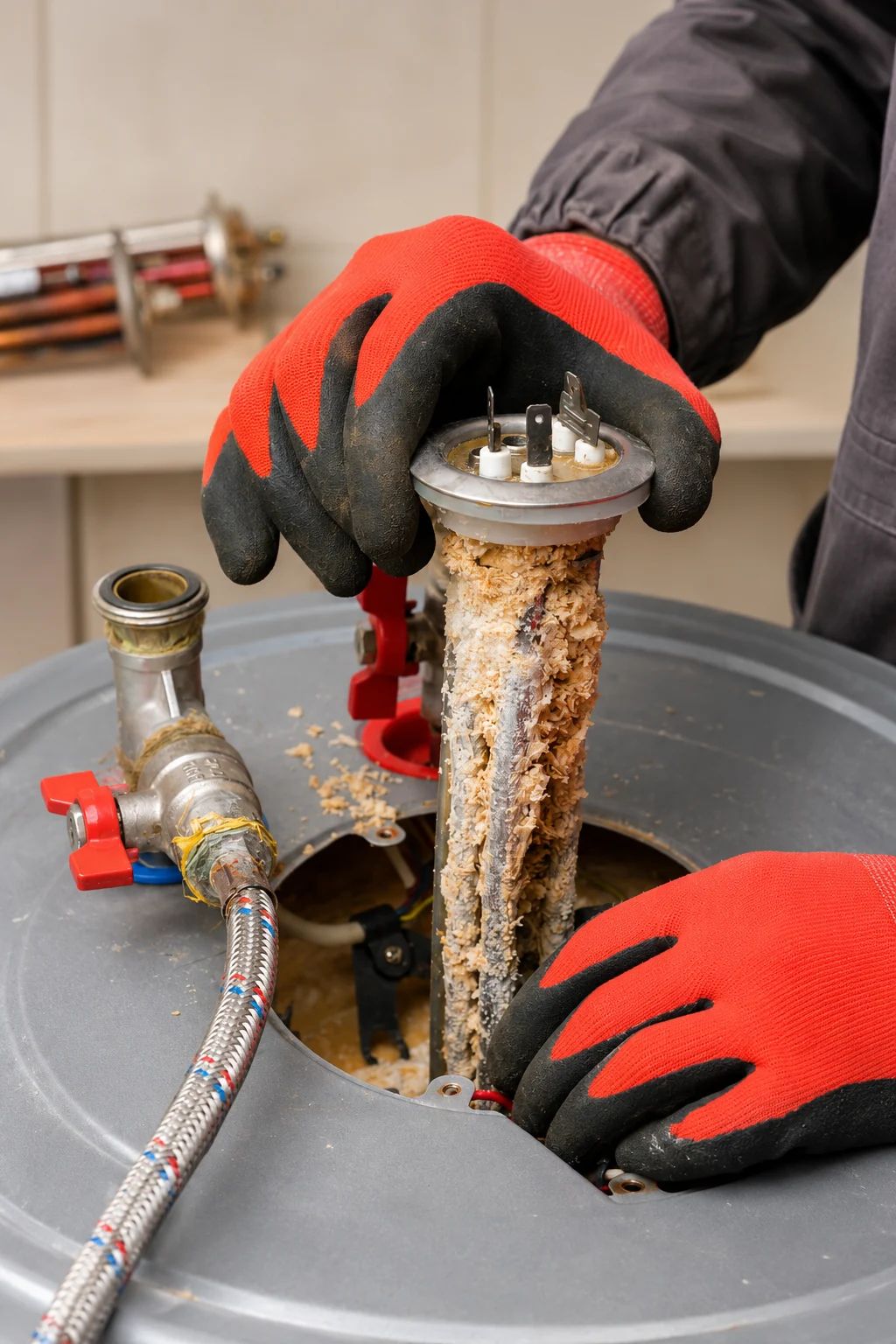
What Builds Up Inside a Hot Water Cylinder?
Over time, different types of deposits can accumulate inside a hot water cylinder. Their composition and location depend on water quality, operating conditions and the materials used in the system.
The most common types of build-up include:
- Limescale: Mineral deposits, mainly calcium carbonate, that form when hard water is heated. They can accumulate on internal surfaces, immersion heaters and the outer surface of heating coils.
- Sediment: Loose mineral particles, debris and other suspended materials that gradually settle at the bottom of the cylinder.
- Corrosion Deposits: Rust, metal oxides and other particles produced by corrosion of metallic components within the water system.
In cylinders with an internal heating coil, deposits can also develop on two separate sides. The outer surface, which contacts domestic hot water, is typically exposed to limescale. Inside the coil, where primary heating water circulates, contamination may consist of magnetite, sludge and corrosion products.
Understanding these differences is important because not all deposits have the same origin or require the same approach to removal.
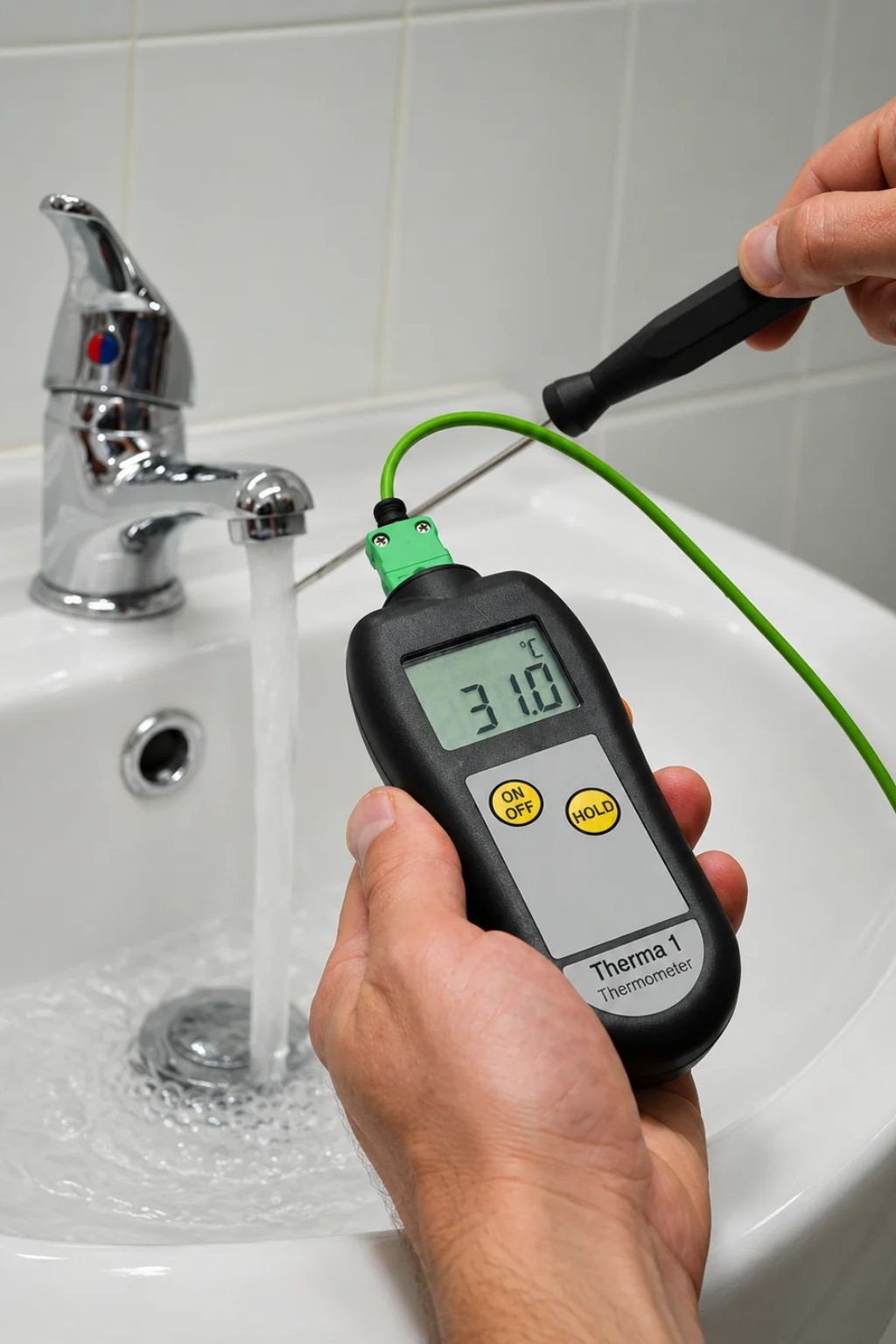
Signs and When Your Hot Water Cylinder May Need Cleaning
A hot water cylinder does not always show obvious signs of internal contamination. However, certain changes in its operation may indicate that accumulated deposits are beginning to affect performance.
Common warning signs include:
- Slower water heating: The cylinder takes longer than usual to reach the required water temperature.
- Reduced hot water performance: Hot water recovery becomes slower, or the available supply no longer meets normal household demand.
- Unusual noises: Rumbling, popping or other unfamiliar sounds occur during heating.
- Visible sediment: Loose deposits or discoloured water are observed during draining or inspection.
- Repeated performance issues: Heating problems continue or return despite routine maintenance of associated equipment.
When Should Cleaning Be Considered?
There is no universal cleaning interval for hot water cylinders. The need for maintenance depends on water hardness, operating conditions, the age of the cylinder and its overall condition.
Even substantial limescale accumulation does not necessarily mean the cylinder needs replacing. If the underlying components remain in good condition, professional cleaning may still be a practical option.
However, these symptoms do not automatically confirm that internal deposits are responsible. Similar problems can result from faults elsewhere in the hot water system. The decision to clean should therefore be based on the actual condition of the equipment rather than symptoms or age alone.
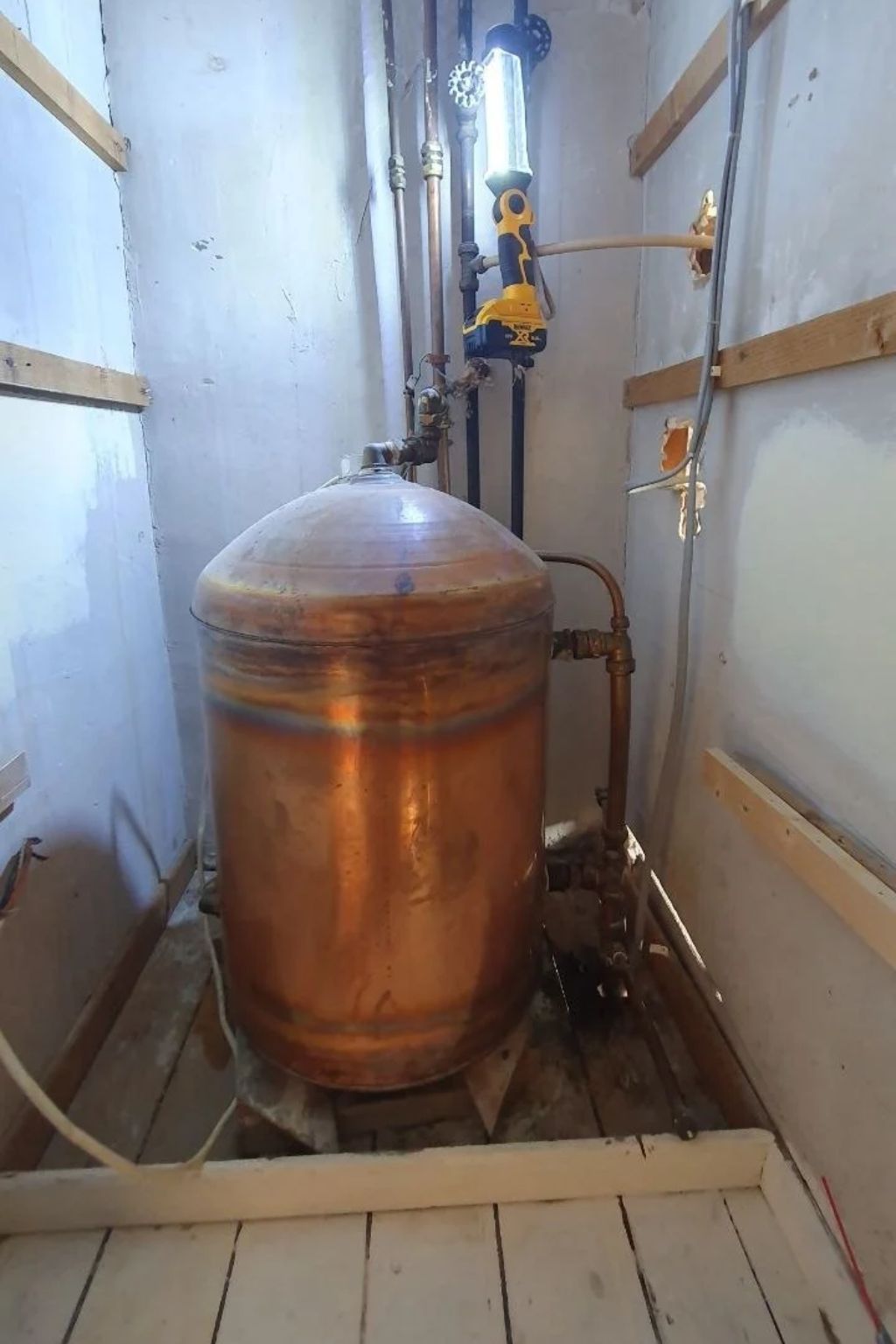
Cylinder Types, Pre-Cleaning Assessment
Not all hot water cylinders can be cleaned using the same approach. Their construction, materials, internal components and overall condition determine which cleaning methods are suitable and whether the work can be carried out safely.
DryZone assesses different cylinder configurations, including vented, unvented and combination systems. Commercial cylinders and calorifiers are considered individually, depending on their design, condition and accessibility.
Pre-Cleaning Assessment
Before recommending a cleaning method, several important factors must be considered:
- Cylinder construction: The type of system, internal arrangement and availability of inspection or service openings.
- Materials and components: The cylinder body, heating coil, immersion heater, protective lining, anode, seals and other internal parts.
- Equipment condition: Signs of corrosion, leaks, damaged coatings, weakened components or previous repairs.
- Safe accessibility: Whether internal components can be reached or removed without risking damage to the cylinder.
This assessment helps determine whether physical cleaning, flushing or chemical descaling is appropriate. Disinfection is a separate treatment intended for microbiological concerns and is not automatically included in cylinder cleaning.
Material Compatibility and Cleaning Restrictions
The materials used in a hot water cylinder determine which descaling methods and cleaning agents can be safely considered. A chemical treatment suitable for copper, for example, may damage aluminium, protective coatings or certain seals.
The following table outlines material-specific considerations for cylinders, heating components and internal fittings. The suitability of any treatment must be confirmed against the equipment manufacturer’s requirements and the cleaning product’s instructions.
| Material / Component | Descaling Suitability | Compatible Agents / Approach | Key Restrictions |
|---|---|---|---|
| Copper cylinder | Generally suitable | Citric acid or inhibited sulfamic acid | Avoid strong mineral acids; consider soldered joints and seals |
| Copper heating coil | Generally suitable | Citric acid or inhibited sulfamic acid | Suitable for circulation cleaning where appropriate |
| 316L stainless steel | Generally suitable | Citric acid or inhibited sulfamic acid | Avoid HCl and chloride-containing cleaners |
| 304 stainless steel | With caution | Citric acid or a compatible inhibited descaler | Risk of pitting corrosion from HCl and chlorides |
| Enamelled / glass-lined steel | Manufacturer approval required | Only manufacturer-approved products | Acidic cleaners may damage the lining; mechanical cleaning preferred |
| Galvanised steel / zinc | Generally unsuitable | Acid descaling not recommended | Acids can dissolve the zinc coating |
| Aluminium | Highly restricted | Only products approved for aluminium | Many acidic and alkaline cleaners cause corrosion |
| Brass fittings | Generally suitable | Citric acid or inhibited sulfamic acid | Avoid aggressive acids and prolonged contact |
| Copper immersion heater | Generally suitable | Citric acid or inhibited sulfamic acid | Prefer separate cleaning; avoid metal scrapers |
| Incoloy immersion heater | Generally suitable | Citric acid or compatible professional descaler | Confirm material and manufacturer requirements |
| Stainless steel immersion heater | Generally suitable | Citric acid or inhibited sulfamic acid | Avoid HCl and chloride-containing cleaners |
| Magnesium anode | Not suitable | Remove or isolate before acid treatment | Must not be acid-cleaned |
| EPDM seals | Depends on compatibility | Confirmed compatible products only | Check concentration, temperature and contact time |
| Unknown gaskets / O-rings | With caution | Identification required | Removal or replacement may be necessary |
| Plastic components | Depends on plastic type | Confirmed compatible products only | Check PVC, ABS, PEX, PP and temperature limits |
Where the material of the cylinder or its components cannot be identified, chemical descaling should not proceed until compatibility has been established.
When Replacement Makes More Sense
Heavy deposits alone are not a reason to replace a cylinder. The decision depends on the condition of the equipment beneath those deposits.
In some cases, accumulated scale can conceal existing corrosion or small perforations. Removing it may expose a leak, particularly when aggressive descaling is attempted on deteriorated equipment.
Replacement may also be more economical when an ageing cylinder requires several costly interventions at once, such as immersion heater replacement, new seals, anode replacement and extensive descaling.
DryZone’s approach is to determine whether cleaning can safely restore reliable operation or whether repair, further diagnosis or replacement is the more appropriate option.
When Cleaning Is Not the Right Solution
The table below explains when cleaning may be appropriate and when further assessment, repair or replacement should take priority.
| Equipment Condition | Cleaning / Descaling | Recommended Action |
|---|---|---|
| Minor or moderate limescale; component in good condition | Suitable | Clean and return to service |
| Heavy limescale; underlying metal in good condition | Generally suitable | Mechanical or compatible chemical cleaning, followed by inspection |
| Severe general corrosion | Not recommended | Replace the affected component |
| Deep pitting corrosion | Not suitable | Replace the damaged component |
| Cracks, deformation or metal swelling | Not suitable | Replace the affected component |
| Active cylinder, coil or immersion heater leak | Not suitable | Repair where permitted and practical, otherwise replace |
| Severe immersion heater sheath corrosion | Not suitable | Replace the immersion heater |
| Damaged immersion heater protective coating | Not suitable | Replace the element |
| Immersion heater fails electrical testing | Not suitable | Investigate and generally replace |
| Damaged immersion heater threads or flange | Requires assessment | Evaluate before attempting cleaning |
| Heating coil perforation or internal leakage | Not suitable | Usually replace the coil or cylinder assembly |
| Severe heating coil corrosion | Not suitable | Replace the coil or cylinder, depending on construction |
| Damaged enamel or glass lining | Chemical cleaning may be unsuitable | Assess coating and manufacturer requirements |
| Completely depleted magnesium anode | Cylinder may remain serviceable | Replace the anode |
| Unknown cylinder or coil material | No chemical descaling | Identify the material first |
| Unknown descaler composition or compatibility | Not suitable | Select a confirmed compatible product |
| No safe access to the component | Do not force disassembly | Consider an alternative method or specialist service |
| Component removal risks damaging the cylinder | Do not force removal | Assess alternative methods |
| Old cylinder in very poor overall condition | Usually uneconomical | Consider cylinder replacement |
| Poor heat transfer or performance persists after cleaning | Further assessment required | Diagnose the cause; replace degraded components where necessary |
Our Hot Water Cylinder Cleaning Process
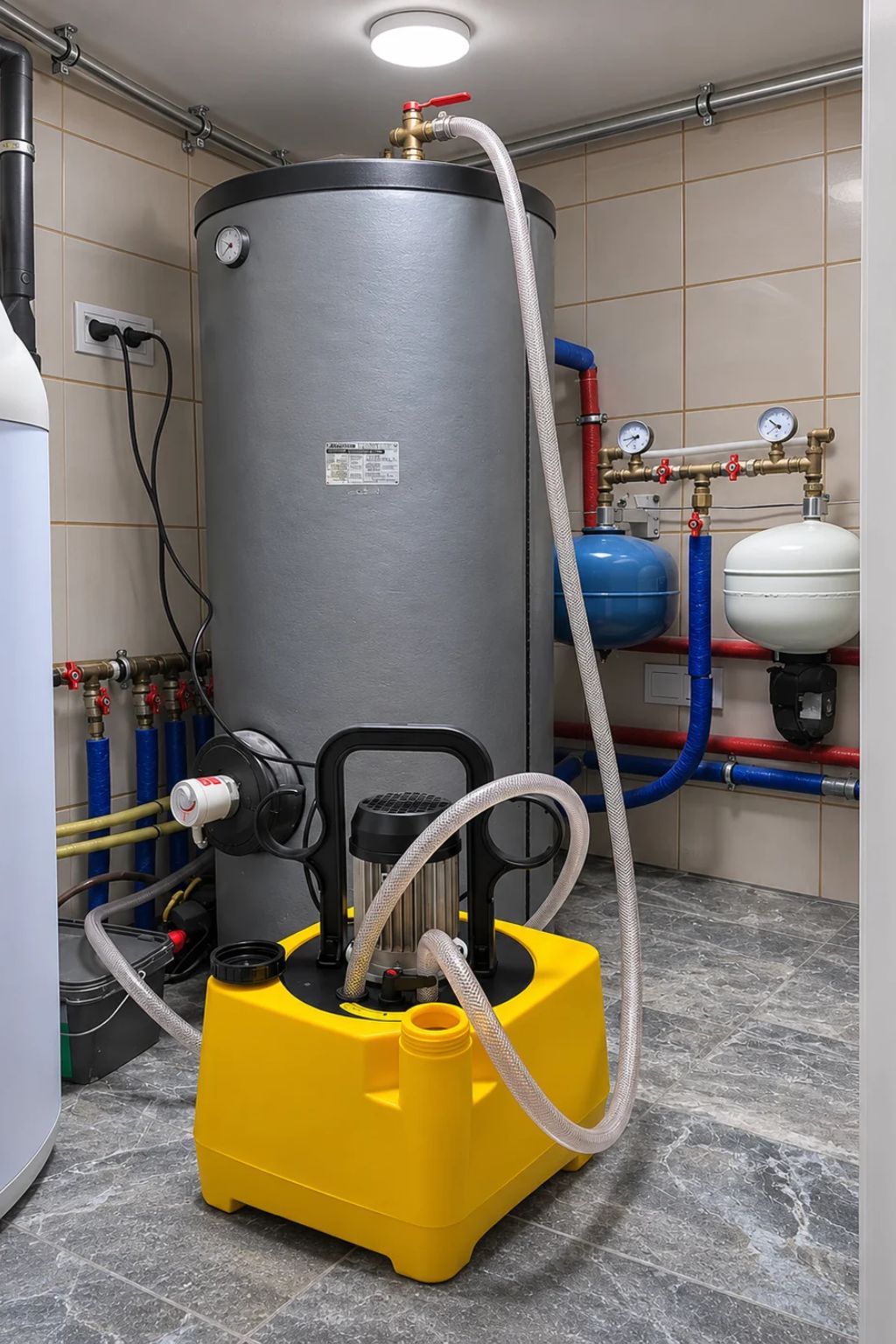
Hot water cylinder cleaning is carried out according to the equipment’s construction, internal accessibility and the type of deposits present. Depending on the cylinder, the work may involve physical removal of sediment, chemical descaling or cleaning specific heating components.
Not every cylinder requires the same procedures. DryZone selects the appropriate approach based on the initial assessment and the agreed scope of work.
1. System Isolation and Preparation
Before cleaning begins, the relevant water supply, heating connections and electrical components are safely isolated as required.
The cylinder is drained to the appropriate level, and accessible inspection openings or removable components are prepared for cleaning. The level of dismantling depends on the cylinder’s construction and available access.
2. Internal Cylinder Cleaning
Where suitable access is available, accumulated sediment, loose limescale and debris can be physically removed from the cylinder.
If deposits cannot be reached mechanically, controlled chemical descaling may be considered, provided the cylinder and all exposed internal components are compatible with the selected treatment.
Following treatment, loosened deposits and cleaning residues are removed through appropriate draining and rinsing procedures.
3. Immersion Heater Cleaning
Immersion heaters can often be cleaned without replacement, provided the heating element remains in suitable condition.
Where removal is possible, the process may include:
- Isolating the electrical supply and draining the cylinder below the immersion heater.
- Carefully removing the element through its flange or threaded connection.
- Removing loose scale and treating remaining deposits with a compatible descaling solution.
- Cleaning the element using a soft nylon brush rather than metal scrapers, wire brushes or abrasive tools.
- Thoroughly rinsing and inspecting the element before refitting it with a suitable gasket or seal.
Threaded immersion heaters can sometimes become seized, making removal difficult. Where an element cannot be safely removed, alternative cleaning methods may be considered if the cylinder construction and materials permit them.
4. Heating Coil Cleaning
Internal heating coils require particular attention because their outer and inner surfaces are exposed to different water circuits.
External Coil Surface (Domestic Hot Water Side)
The outer surface of the heating coil is in contact with domestic hot water and may accumulate limescale that restricts heat transfer.
Where a sufficiently large inspection opening is available, accessible deposits can be removed mechanically. If physical access is limited, chemical descaling of the cylinder’s domestic hot water space may be considered, subject to material compatibility and manufacturer approval.
Internal Coil Surface (Primary Heating Side)
The inside of the coil carries water from the boiler or heat pump circuit. Contamination here may involve magnetite, sludge or corrosion deposits rather than ordinary limescale.
Where internal restrictions are identified, the coil may be isolated and cleaned separately using a circulation pump connected between its flow and return connections. The direction of circulation can also be reversed where appropriate.
This requires a cleaning product suited to the contamination found in the primary heating circuit. Such work is distinct from cleaning deposits on the domestic hot water side and may require a separate heating-system cleaning procedure.
5. Flushing and Reassembly
Following the selected cleaning procedures, the treated sections are flushed to remove loosened deposits and remaining cleaning residues.
Any components removed during the work are refitted with suitable seals or gaskets as required. The cylinder is then prepared for refilling, final safety checks and recommissioning.
The exact cleaning procedure depends on the cylinder’s condition and construction. The aim is to remove deposits effectively without causing unnecessary damage to the equipment.
Final Checks and System Recommissioning
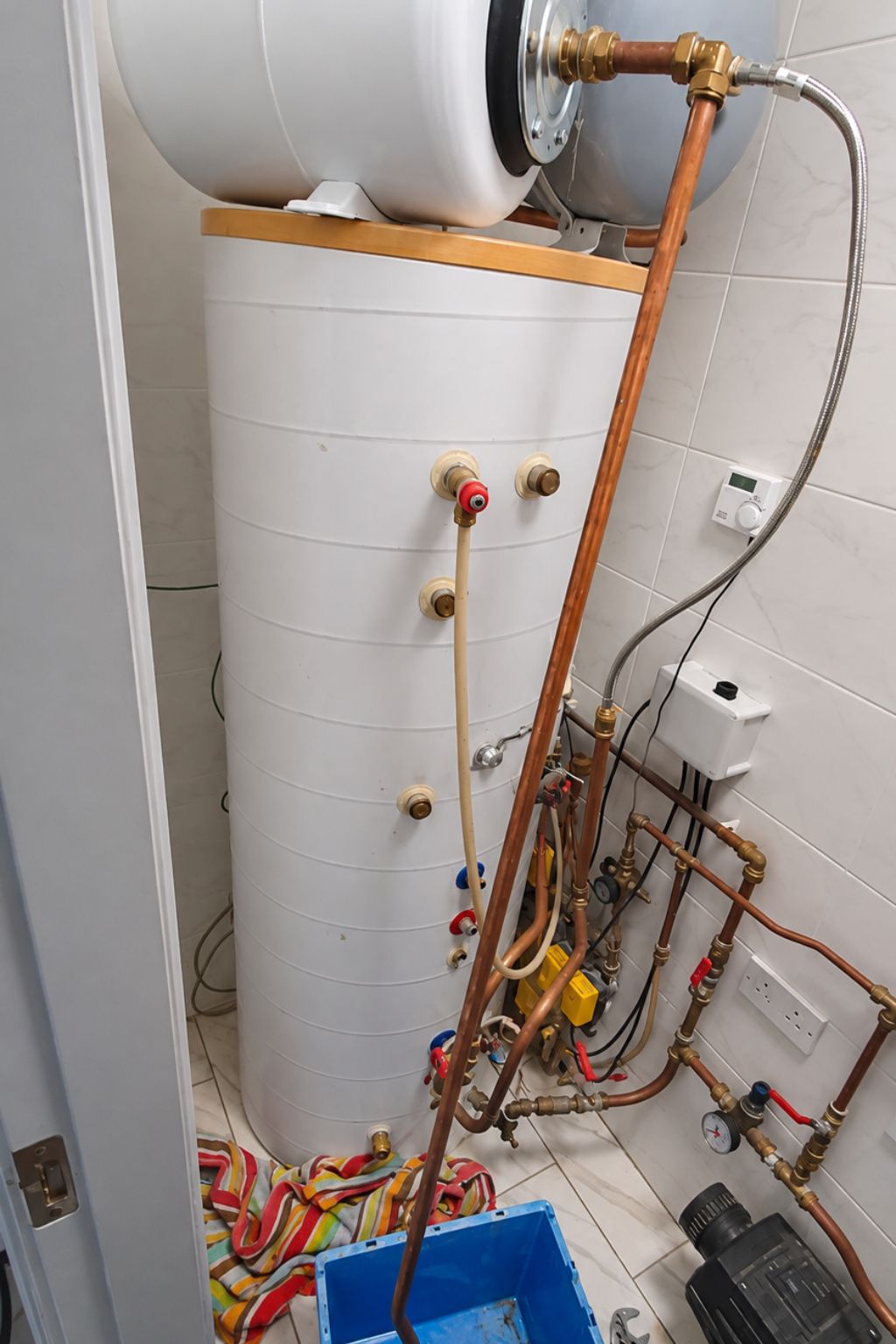
Once cleaning is complete, the hot water cylinder must be safely returned to operation. Final checks help confirm that the equipment has been correctly reassembled, connections are secure and the system is functioning as intended.
The checks performed depend on the cylinder’s construction, the components serviced and the agreed scope of work.
Reassembly and Leak Inspection
Any components removed during cleaning are checked for correct installation, with particular attention to flanges, threaded connections and seals. Once the cylinder is refilled, accessible joints and connections are inspected for signs of leakage.
Refilling and Safe Start-Up
The cylinder must be completely refilled and air removed from the system before power is restored to an immersion heater. Energising an immersion element without sufficient water can cause rapid overheating and permanent damage, commonly known as dry firing.
Immersion Heater and Electrical Safety Checks
Where an immersion heater has been serviced, its condition must be assessed for deterioration, including corrosion, pitting, cracks, swelling or damage to the protective sheath.
Appropriate electrical testing is also important. Measuring the element’s operating resistance alone does not confirm its electrical safety. Where applicable, insulation resistance testing using a suitable tester (megger) can help identify insulation faults between live conductors and the metallic sheath or earth.
Electrical checks must be carried out by a suitably competent person. An element that fails the required safety checks should not be returned to service until the fault has been addressed.
Functional Performance Verification
Following recommissioning, the system is checked for correct operation, including water heating and the performance of serviced components where applicable.
If heating performance remains unsatisfactory, further diagnosis may be needed to identify problems that cleaning alone cannot resolve.
The purpose of these final checks is to confirm that the serviced equipment can be returned to operation safely, rather than assuming that removing deposits has resolved every underlying problem.

Water Testing and Prevention of Recurring Problems
Cleaning a hot water cylinder removes existing deposits, but it does not address the water conditions that may have caused them. If these conditions remain unchanged, limescale and other deposits can gradually accumulate again.
Where recurring build-up is a concern, professional water testing can help identify contributing factors, including:
- Water hardness: Elevated calcium and magnesium levels that contribute to limescale formation.
- Iron and manganese: Minerals that may contribute to staining and sediment-related problems.
- Water chemistry: Parameters such as pH and alkalinity that can help assess scaling and corrosion-related conditions.
Based on the results, DryZone can recommend suitable water treatment solutions, such as water softening to reduce hardness or appropriate filtration where other contaminants are present.
The aim is to address the underlying water quality issues where possible, helping reduce recurring deposits and protect the cylinder and associated hot water equipment over time.
Service Records and Technical Findings
Keeping a record of hot water cylinder maintenance helps homeowners, landlords and property managers understand what work has been carried out, track the condition of their equipment and make informed decisions about future servicing.
Depending on the work performed and individual customer requirements, DryZone can provide supporting documentation, including:
- Before-and-After Photographs: Visual records of accessible internal surfaces, heating components and the results of cleaning.
- Work Summary: Details of the cylinder serviced, cleaning methods used and components inspected or treated.
- Technical Observations: Findings relating to the cylinder’s condition, visible deterioration, relevant measurements or defects identified during servicing.
- Maintenance Recommendations: Advice on any additional repairs, component replacements or preventive measures that may be beneficial.
- Water Analysis Reports: Laboratory findings where water sampling and testing have been arranged as a separate service.
- Additional Documentation: Itemised invoices, technical reports and supporting information for insurance-related requirements where applicable.
The level of documentation is determined by the service provided and any additional reporting agreed in advance. These records can also serve as a useful reference when planning future maintenance or investigating recurring performance issues.
Hot Water Cylinder Cleaning
Based in Shannon, DryZone provides professional hot water cylinder cleaning, descaling and maintenance services across County Clare and County Limerick.
We also cover selected towns and villages in Galway and Tipperary upon request.
If your property is outside our main service area, contact us to check availability.

FAQs
Not necessarily. In many cases, cleaning can be carried out while the cylinder remains installed, using available service openings, connections or removable components. However, the options depend on the cylinder’s design and accessibility. Some installations may require additional dismantling or an alternative approach.
Yes, the affected hot water supply will normally be temporarily unavailable while the cylinder is isolated, drained or serviced. Hot water can be restored once the necessary work, refilling and safety checks have been completed.
The duration depends on the cylinder’s size, construction, accessibility and the extent of the deposits. Cleaning a readily accessible component may be relatively straightforward, while extensive descaling or difficult-to-remove parts can require additional work. DryZone can provide a more accurate assessment once the equipment and required procedures are understood.
Not necessarily. Cleaning the domestic hot water side of a cylinder does not automatically require draining the entire central heating system. However, if work involves the internal primary heating coil or its connections, additional isolation or partial draining of the heating circuit may be necessary.
Only if the reduced flow is caused by deposits in a section that can be effectively cleaned. Poor hot water pressure may also result from pipework restrictions, valves, supply conditions or other plumbing issues. Cleaning the cylinder alone cannot be guaranteed to resolve these problems.
Physical cleaning and descaling are intended to remove accumulated deposits, not to provide verified microbiological disinfection. If bacterial contamination is suspected, a separate water hygiene assessment, appropriate testing or disinfection procedure may be required. Cleaning alone should not be treated as confirmation that the water is microbiologically safe.
It is helpful to ensure clear access to the cylinder, including any surrounding panels, cupboards or service areas. If available, information about the cylinder’s model, age and previous maintenance can also assist with the initial assessment. There is no need to drain or dismantle the equipment yourself before the visit.